Interior vs Exterior Waterproofing Methods
Basement waterproofing generally falls into two categories — interior and exterior. Each has distinct advantages, and the right choice depends on your foundation type, soil conditions, budget, and whether your home is built on the Canadian Shield or in the Ottawa Valley's deeper soils.
Exterior Waterproofing
Exterior waterproofing involves excavating the soil around the foundation down to the footing level. A waterproof membrane — typically polymer-modified asphalt or rubberized asphalt — is applied to the cleaned exterior foundation wall. A drainage board (dimpled plastic sheet) is installed over the membrane to create an air gap and direct water downward to the weeping tile system at the footing. The weeping tile, usually perforated PVC pipe wrapped in filter fabric, carries water away to a sump pit or daylight outlet.
In Renfrew County, exterior waterproofing is the gold standard for new construction and for existing homes with severe leakage. The excavation must be dug below the frost line — typically 4–5 feet in this region — to install the system where it can effectively intercept groundwater. The cost is substantial, ranging from $10,000 to $25,000+ for an average home, because of the excavation, material, and restoration work involved.
Interior Waterproofing
Interior waterproofing (often called an interior drainage system) does not attempt to keep water out of the wall. Instead, it manages the water that enters by providing a path of least resistance. A channel is cut into the basement floor along the perimeter of the foundation wall. Perforated PVC drain tile is laid in this channel, covered with gravel, and the concrete is restored. Water entering at the wall-floor joint (cove joint) or through wall cracks is captured by the drain tile and directed to a sump pump pit, from which it is pumped out of the building.
Interior systems are particularly well-suited for Renfrew County homes built on shallow bedrock. When bedrock prevents exterior excavation to the proper depth, an interior drainage system is often the only practical option. Costs typically range from $3,000 to $7,000 for an average home.
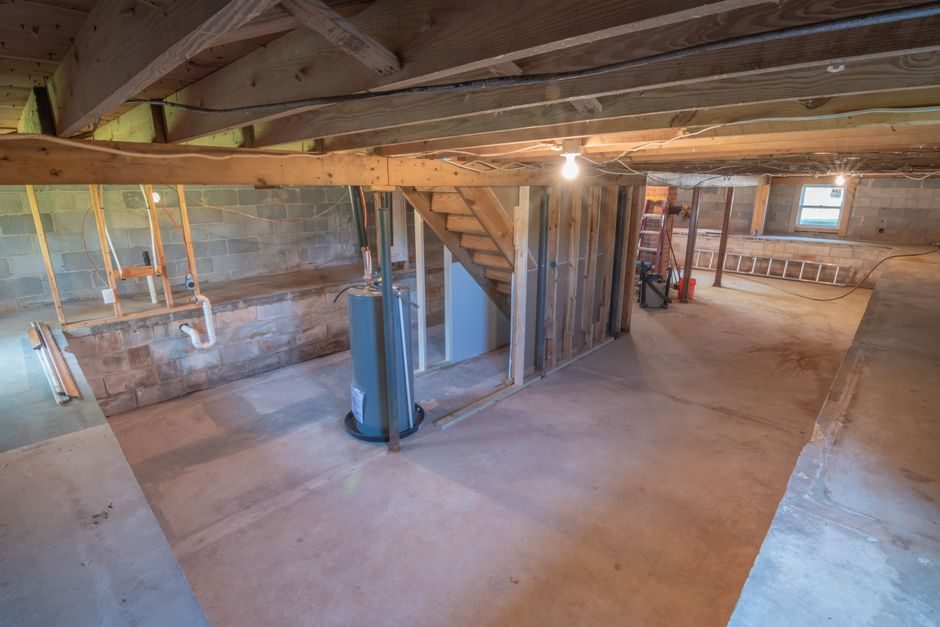
Membrane Systems and Drainage Board
The waterproofing membrane is the primary barrier against moisture on an exterior system. Several types are used in Renfrew County:
- Polymer-modified asphalt membranes — The most common choice. Applied by trowel or spray. Forms a flexible, durable coating that bonds to concrete. Typical lifespan 30–50 years.
- Rubberized asphalt membranes — Higher performance option. Self-adhering sheets that provide excellent crack-bridging ability. More expensive but more durable.
- Sheet-applied membranes — Pre-manufactured sheets of rubberized asphalt with a polyethylene backing. Consistent thickness and reliable performance.
- Liquid-applied membranes — Applied like paint but much thicker. Good for irregular surfaces but requires careful application.
Drainage board is installed over the membrane to protect it during backfilling and to create a drainage plane. The dimpled plastic sheet creates a 1/4" to 3/4" gap that allows water to flow freely down to the weeping tile without being trapped against the membrane. This is critical in Renfrew County's clay soils, which hold water against the foundation for extended periods during wet seasons.
Pro Tip for Shield Properties
If your home in Renfrew County is built on bedrock or has very shallow soil over rock, a membrane-only system without drainage board may be less effective. The lack of soil means water runs directly off the rock and concentrates against the foundation. A drainage board ensures this water has a path to the weeping tile. For properties where exterior excavation is impractical, an interior system is recommended.
Weeping Tile Systems
Weeping tile (also called drain tile or footing drain) is the backbone of any foundation drainage system. In modern installations, perforated PVC pipe wrapped in filter fabric is laid in a gravel bed at the footing level around the entire perimeter of the foundation. Water entering the drain tile flows by gravity to a sump pit or away from the building at a daylight discharge point.
In older Renfrew County homes (pre-1980s), original weeping tile systems were often clay tiles laid without filter fabric. These systems are frequently clogged with silt, collapsed from frost heave, or crushed by tree roots. Many Renfrew County homeowners with wet basements discover their original weeping tile is non-functional. In these cases, either a full exterior replacement or an interior drainage system is needed.
Cost Comparison Table
| Method | Cost Range (CAD) | Invasiveness | Lifespan |
|---|---|---|---|
| Exterior — full membrane + drainage board + weeping tile | $12,000 – $30,000 | High (full excavation) | 30–50 years |
| Exterior — weeping tile replacement only (no membrane) | $8,000 – $18,000 | High (partial excavation) | 20–30 years |
| Interior perimeter drainage system | $3,000 – $7,000 | Low-moderate (floor cutting) | 20–30 years |
| Sump pump installation only | $400 – $1,500 | Low (floor core drill) | 7–10 years (pump) |
| Crack injection (per crack) | $250 – $800 | Minimal | 10–20 years |
Renfrew County Soil and Frost Considerations
The soil conditions across Renfrew County vary enormously, and the waterproofing approach that works on one property may fail on another just a few kilometres away. Understanding your specific soil type is essential before deciding on a method.
Clay Soils (Ottawa Valley)
In the Ottawa Valley corridor — including Renfrew, Arnprior, Cobden, and parts of Pembroke — heavy clay soils are common. Clay holds water, expands when wet, and contracts when dry, creating significant pressure against foundation walls. Clay also takes much longer to drain than other soil types, meaning hydrostatic pressure remains high for days or weeks after heavy rain. Exterior waterproofing with drainage board is strongly recommended in clay soil areas.
Thin Soil over Bedrock (Shield)
In the western parts of Renfrew County — Eganville, Killaloe, Barry's Bay, Combermere, Madawaska — homes are often built on thin soil over the Canadian Shield bedrock. Here, water runs off the rock surface and concentrates against the foundation. Traditional weeping tile at footing depth may not be feasible if bedrock is at or near the surface. Interior drainage systems are often the practical choice.
Sandy Soils (Ottawa River)
Properties along the Ottawa River near Pembroke, Petawawa, and Deep River may have sandy or gravelly soils. These drain quickly, which is favourable for basement water management, but they also settle more easily, which can cause foundation cracks over time.
Frost Depth
The frost line across Renfrew County generally reaches 4–5 feet (1.2–1.5 metres). Any exterior waterproofing or drainage system must be installed below this depth to prevent frost heave from damaging the system. Interior systems are not directly affected by frost depth, but the sump pump discharge line must be protected from freezing at its exit point.
Step-by-Step Exterior Waterproofing Process
- Site assessment — Contractor evaluates soil type, foundation condition, water source, and determines if a permit is needed.
- Excavation — Soil is excavated around the perimeter down to the footing, typically 4–5 feet deep. In Shield areas, this may involve breaking rock.
- Foundation preparation — Wall is cleaned of soil, efflorescence, and loose material. Cracks are repaired and patched.
- Primer application — A bonding primer is applied to the clean concrete surface if required by the membrane system.
- Membrane application — Waterproof membrane is applied (trowel, spray, or sheet) to the full height of the exposed wall.
- Drainage board installation — Dimpled drainage board is installed over the membrane, extending from grade to footing.
- Weeping tile installation — Perforated PVC pipe in a gravel bed is laid at the footing, connected to the sump or daylight outlet.
- Backfill and restoration — Aggregate is backfilled carefully to avoid damaging the drainage board, then topsoil and grading are restored.
Related Information
Interior Drainage Systems
Sump pumps, perimeter drains, and interior solutions for Renfrew County homes.
Learn MoreFoundation Crack Repair
Epoxy and polyurethane crack injection, carbon fibre straps for Renfrew County foundations.
Learn More